

Fire safety
Fire regulations
Two decrees recently published in the Journal Officiel of 11/08/2019 change fire regulations in two cases:
For renovation of IMH buildings (28 to 50 meters high)
- From January 1, 2020, for all building permits, at least some of the products used for façade renovation must be at least class A2-s3,d0. Products not meeting this class must be protected by a thermal shield (e.g. EPS insulation covered by rockwool insulation).
- Regardless of the solutions used, the systems must be validated by a laboratory assessment.
For dwellings where the highest floor is no more than 50 metres away.
- First family: exterior cladding at least class D-s3,d0 or E if home is insulated.
- Second family: exterior cladding at least class D-s3,d0
- Third family, two solutions:
- All products are at least class A2-s3,d0
- The system has been validated by an APL irrespective of its fire rating.
- Fourth family: two solutions identical to renovation (see paragraph above).
CAREA® products and fire regulations
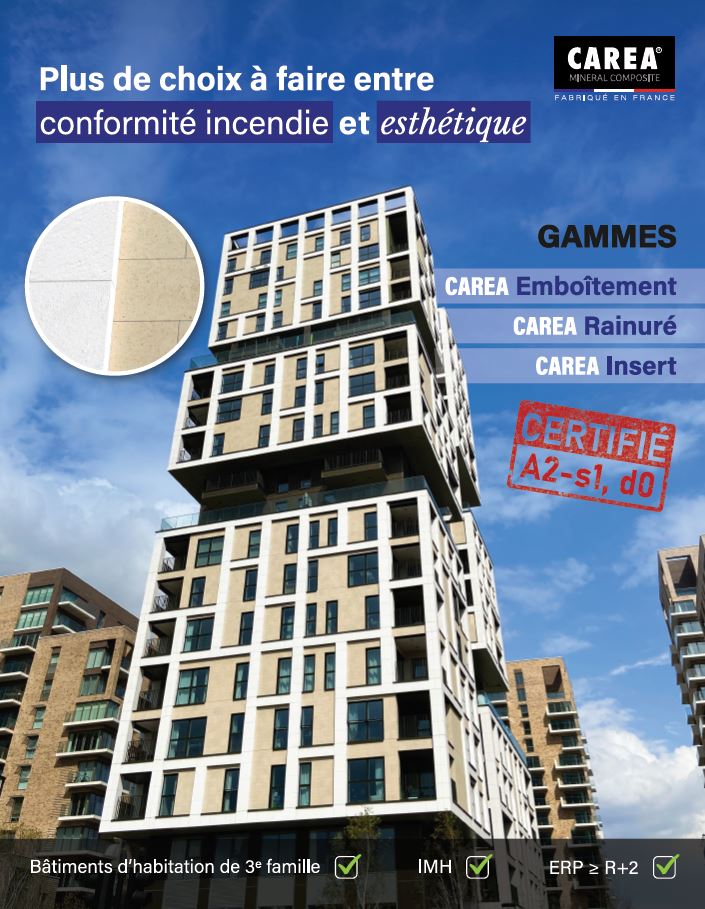
No need to choose between fire safety and aesthetics!
For both construction and renovation, our grooved, interlocking and anchor product ranges are A2-s1,d0 certified: our material is non-flammable and does not propagate fire.
For frameless applications, the interlocking and grooved ranges are laboratory-tested for3rd family residential buildings.
For use with framing, the grooved range has been laboratory-tested to validate solutions without or with invisible lip.
Our solutions can be applied to all types of building, both new construction and renovation (IGH, IMH,3rd family dwellings, etc.).
CAREA® Grooved cladding: no longer visible flap
Since the publication of a laboratory assessment (APL n°EFR-16-002964 – Revision 2), CAREA grooved cladding in horizontal and vertical installation, used with Rockwool rockwool insulation, can be installed with an invisible overlap flap.
This APL is designed to :
- 1st group ERP from R+2,
- 3rd family residential buildings,
- IMH.
The following construction system is required:
- Concrete or rendered masonry substrate.
- Vertical steel frame; EPDM strips are required at each intersection between the steel frame and the horizontal aluminum rail.
For ERP buildings where the C+D rule does not apply, as well as for residential buildings, the air gap overlap can be managed in one of the following ways:
- Steel frame; in this case, no air gap overlap.
- Bay frame with slab return + invisible steel skirting or Hilti-type intumescent strip.
For ERP where the C+D rule applies, the air gap must be intersected, whatever the type of opening frame. This is achieved either by means of an invisible bib, or with a Hilti-type intumescent strip.